
NUUANU DAMS
Hawaiʻi Dam and Reservoir Safety Program
The Hawaiʻi Dam and Reservoir Safety Program administered by the Hawaiʻi Department of Land and Natural Resources (DLNR) Engineering Division exists to protect the health, safety, and welfare of the citizens of the State by reducing the risk of failure of the dams or reservoirs.
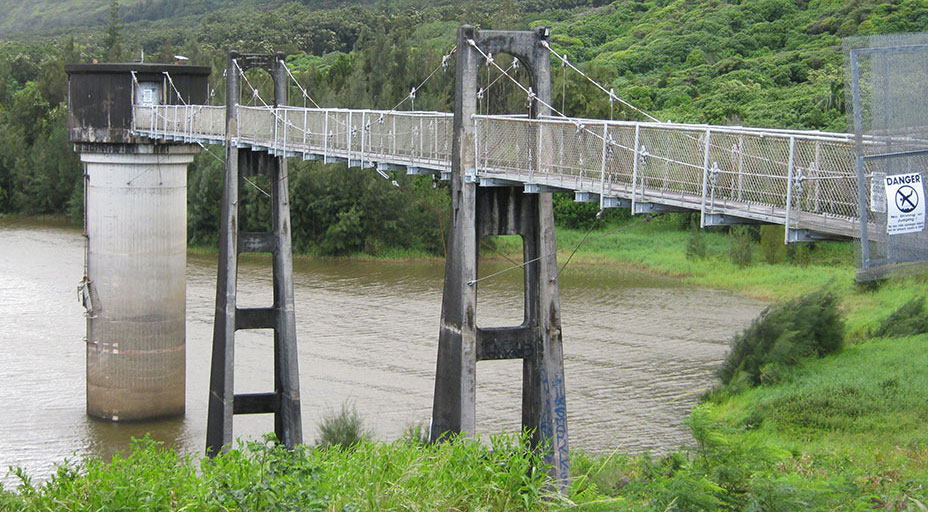
Dams are a barrier constructed to hold back water resulting in a pool that can be used for a variety of purposes; agriculture, water supply, electricity generation, flood or sediment mitigation.
- History of Dams in Hawaiʻi
- Since the late 1800’s and early 1900’s many dams were built to support agriculture across the state.
- Timeline of the Dam Safety Regulatory Program
- 1980 - US Army Corps of Engineers conducts Phase I inspection of High Hazard dams and develops the Hawaiʻi regulated dam inventory
- 1987 - Dam Safety Act (HRS 179D)
- 1989 - Hawaiʻi Administrative Rules (HAR) 13-190
- 2006 - Kaloko Dam failure
- 2007 - Update “Hawaiʻi Dam and Reservoir Safety Act of 2007” (HRS 179D)
- 2012 - Update “Dams and Reservoirs” (HAR 13-190.1)
- Regulatory Size
- Greater than 25‐ft high and 16.3 million gallons in volume, but nothing less than 6‐ft tall, or 4.9 million gallons in volume
- Statistics (October 2018)
- Regulates 131 dams and reservoirs statewide:
- Hawaiʻi (10)
- Maui (56)
- Oʻahu (13)
- Kauaʻi (52)
- Regulates 131 dams and reservoirs statewide:
Hawaiʻi Department of Land and Natural Resources:
- Dam Safety Website
- Inventory Website of Dams in Hawaiʻi
- Online Dam Evacuation Area Tool (Flood Hazard Assessment Tool)
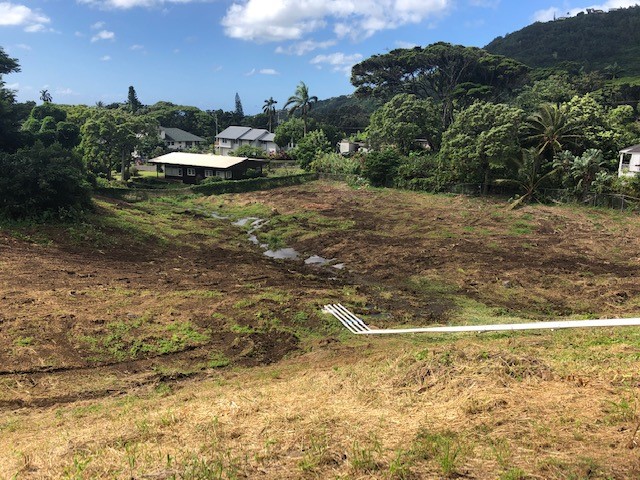
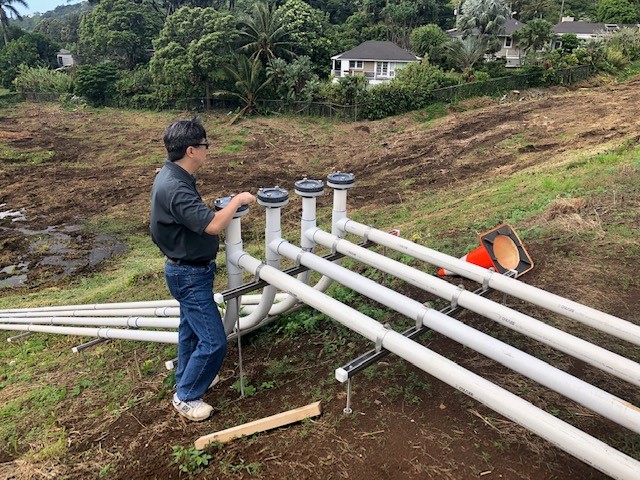
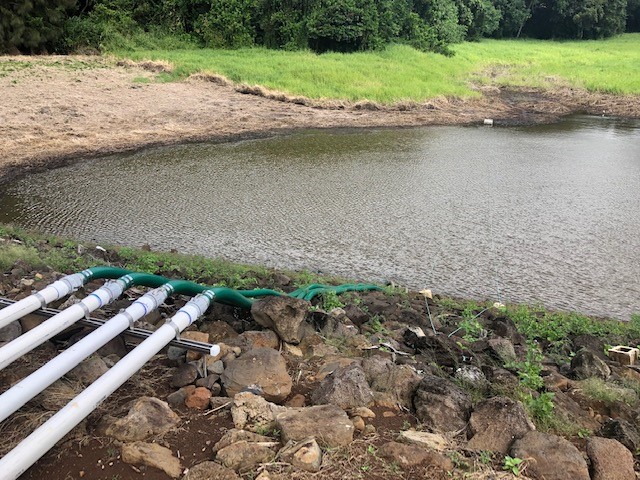
These photos show the siphon system which helps to maintain the water level in the Nuʻuanu 1 reservoir.
Program FAQs
Why should I care about dams?
Dams provide a great asset to the community by providing stored water for irrigation, drinking, energy generation and flood and sediment control. However, they come with risks if there were to be a dam failure. Not only the flooding of the community, but also the loss of the asset and its benefits.
What are risks associates with dams?
Dam failures can be structural, mechanical or hydraulic in nature.
- Structural – foundation defects causes the failure of the embankment
- Mechanical – malfunctioning gates or valves can cause a dam failure
- Hydraulic – overtopping due to inadequate spillway design or as a result of other causes
Am I or could I be affected by a dam and what is the dam failure flood inundation area?
- Yes, potentially, if you live downstream of a dam. Flood inundation areas and water flow down natural tributaries can be modeled. There is a potential for stream banks and drainage ways to be overtopped during a dam break due to an increase in flow.
- You can find out if you live in a Dam Evacuation area by visiting http://gis.hawaiinfip.org/fhat/ or http://dlnreng.hawaii.gov/dam/ for more information about the program.
- The evacuation area is a much larger area that may be affected by flooding. The evacuation area is designed by emergency managers to control the movement of people in and out of the potential hazard zone, and determined by the roadway network of a particular neighborhood.
Once I determine that my property is in a dam break inundation area, what’s next?
- Know where the dam is located, compared to your location.
- Find out the downstream channel and tributary stream or drainageway downstream of the dam.
- Become familiar with the streets and major roadways that would be closed in the event of a potential dam break.
- Become aware of how to move away from the potential flood wave. Depending on the downstream tributary, which direction to move, including vertical evacuation.
NOTE: Information is current as of the time it was posted online and is subject to change and update as new information becomes available. Please visit the Hawaiʻi Dam and Reservoir Safety Program website for the latest information.
Updated: 10/04/2023